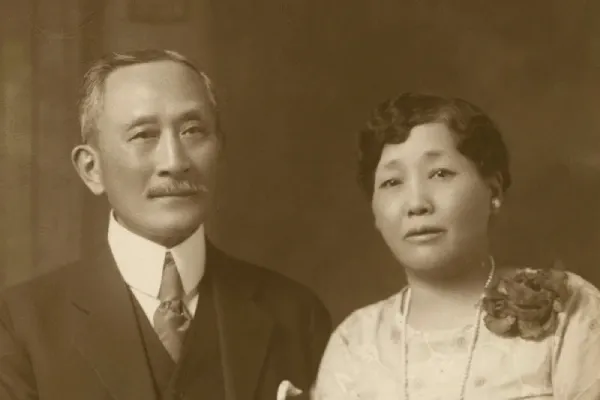
Won Alexander Cumyow and Eva Chan, Vancouver, circa 1920s. Knowing both names gives a family researcher a useful second clue.
Marian grew up writing her family name Jen. The same surname, 任, also appeared as Ren. If those were the two spellings on your kitchen table, which would you type into a Canadian archive? Start with the one your relative used in Canada. Keep the other for a second search. Before you open either result, pick one detail you would expect to find alongside the name. A spouse, a street or a hometown gives you something to check when the spelling looks beautifully, temptingly right.
In Marian’s December 2016 account of tracing her ancestors, a souvenir she picked up in China got her curious about her surname. The breakthrough came later, in papers her siblings had kept. Her father had written down his own name, his father’s name and the family hometown, Yixing in Jiangsu. Someone who could read the characters helped Marian get them into a form she could type. The souvenir told her something about a name. Her father’s handwriting gave her a particular family to look for.
Give each spelling its own line
Pick one person. Copy the name exactly as it appears on one item, even if someone has since pencilled a different spelling on the back. Give the pencil note its own line. Photograph both sides if you have permission. If you cannot read the characters, keep the image and ask someone who reads Chinese to transcribe them. You can ask how they might be written in English as a separate question. That way you’ll still know which letters came from the envelope and which came from the conversation.
Here is a small note worth keeping beside the search box. You can copy it onto the back of a spare sheet of paper.
- Name as written — include the characters, spaces and order you can actually see.
- Where I found it — for example, “front of Mum’s envelope” or “Auntie’s reading of the pencil note, by phone today”.
- One other clue — a town, a relative, an address or an approximate year. Say who supplied it.
- What to try next — write one search, then add the collection, spelling and result after you try it.
If all you have is a sound, ask, “Who called him that?” The answer might be “his sister” or “everyone at the shop”. Either is worth writing down. Leave the characters blank until somebody can identify them.
Change one part of the search
The couple in the photograph offer a good example. Vancouver Public Library uses Won Alexander Cumyow to explain how names move between fields. His surname was Won. Some indexes put Won, or Wan, in the given-name field. If you already knew his name, you could still miss him by filling in every box correctly.
Start with the fullest name you know. If the search comes back empty, try the most distinctive part on its own — in this example, Cumyow. Then try the surname in the other name field. For two documented spellings like Jen and Ren, run the same search twice, changing just that word. Keep the collection and date range steady. When one version works, your note will tell you exactly what made the difference. Vancouver Public Library’s name-search examples show variations worth trying.
Choose a collection that could contain the person. For someone known to have lived in Canada in a particular census year, a census return can put a name in a household. For a relative who immigrated, compare the approximate arrival year with the collection’s coverage. Library and Archives Canada lists its Immigrants from China, 1885–1952 database alongside census and other sources. A person born in British Columbia, as Cumyow was, calls for a different search from a parent who arrived there. Canadian records guide
Decide what earns a place in the family tree
Suppose two census entries turn up with your grandfather’s surname and roughly the right age. One man lived on the street your aunt remembers. The other shared a household with someone whose name matches your grandmother’s. Open both original returns if images are available. Read the relationship column. The woman with the familiar name might be listed as a sister. Check when your aunt remembers the street, too. A perfectly good address from the 1950s can send you to the wrong door in the 1930s.
Save the reference for each entry. Beside it, write what fits, what conflicts and what would settle the question. If the original is unavailable, mark the entry “index only”. If both men still fit, keep both as possibilities and leave the tree alone for now.
Marian’s family papers suggest a good question for the next phone call. Instead of asking a relative to remember the whole family history, ask, “Do you have anything where they wrote their own name?” Even if the answer is just an old envelope, you’ll know whose hand held the pen.